Object NP-RMB-001
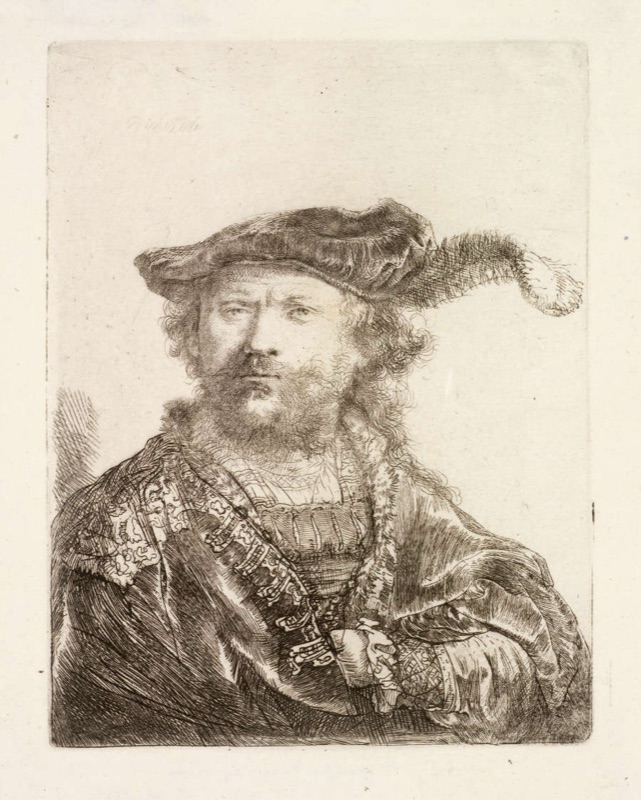
Self-Portrait in a Velvet Cap with Plume
Rembrandt Harmenszoon van Rijn, 1606–1669 · 1638 · Drypoint etching (Bonhams); etching in most institutional records
One impression of a print that exists in many. This is its research record: what is known, what is only reported, and — at greater length — what nobody has established yet.
Printed at 1:1. The plate mark above measures 134 × 103 mm, height before width, as the plate dimensions are recorded for this composition. Check against a rule before measuring from it; some printers scale to fit.
What the record establishes
The plate is Rembrandt’s, worked in 1638 and signed in the plate.
Verified against the catalogue raisonné entry for New Hollstein 170, which records it signed and dated upper left, Rembrandt f 1638.
This sheet is catalogued as state III of four — a state the catalogue says is not Rembrandt’s work.
New Hollstein describes the third state as probably rebitten, with the cap strengthened and cross-hatching added, and ends the description: “Not by Rembrandt.” If the attribution holds, this impression was pulled after the plate had passed out of his hands.
It was bought at Bonhams, New York, as lot 182 of sale 28358, in 2023.
Transcribed from the payment receipt and confirmed against the published lot page. The catalogue entry supplies the medium, the sheet size, the condition and the state determination.
The verso is blank.
Photographed. No collector’s mark, no stamp, no inscription, no dealer’s code — which closes the most likely route into the sheet’s earlier ownership.
What it does not
Whether a specialist agrees it is state III.
The determination is one auction cataloguer’s, made in a books-and-manuscripts sale. Nobody with a print room behind them has compared this sheet against the catalogue’s diagnostic features. That verdict decides whether the impression is Rembrandt’s work or the print trade’s.
When exactly it was printed.
If it is state III, it was pulled after the plate was reworked — probably in its French afterlife, somewhere between the 1780s and the 1840s. The paper has never been examined, and the catalogue records no watermarks at all for this state.
Anything about its condition, from anyone qualified.
No paper conservator has seen the sheet. There is no condition report, no technical imaging, and no assessment of whether the dampstaining is stable.
Questions a specialist could answer
Each is scoped small enough to finish. Several need nothing but a photograph.
Is this impression New Hollstein 170, state III?
medium difficulty· suits a student projectRQ-04Does the sheet carry a watermark, and can it narrow the period in which this impression was printed?
high difficultyRQ-05What is the chain-line spacing, and does it match any impression already recorded in the census?
medium difficulty· suits a student projectA census of the impressions, not of one impression
27 records of this print in public collections and on the art market, each transcribed from the holding institution’s own published record, each with the source URL against it. Institutions disagree with one another about the state division and the dimensions; where they do, the disagreement is recorded rather than resolved.
It is the part of this project that is useful to someone with no interest at all in a privately held sheet.
Open the census- Rijksmuseum
- Staatsgalerie Stuttgart, Graphische Sammlung
- Victoria and Albert Museum
- Harvard Art Museums / Fogg Museum
- National Gallery of Art
- National Gallery of Victoria
- Statens Museum for Kunst (SMK)
- The British Museum
- The Morgan Library & Museum
- Art Institute of Chicago
- Cleveland Museum of Art
- Fine Arts Museums of San Francisco (Achenbach Foundation for Graphic Arts)
- Herzog Anton Ulrich-Museum
- Museum Boijmans Van Beuningen
- Museum of Fine Arts, Boston
- Princeton University Art Museum
- RISD Museum (Rhode Island School of Design)
- Swann Auction Galleries (sale 2566, 'Old Master Through Modern Prints', 6 May 2021, lot 87)
Recent changes
Full changelog- 2026-08-13
The object header no longer asserts drypoint without saying who said it
correction
- 2026-08-13
Bonhams declines to add to the 2023 entry; recorded as a negative finding, not as silence
addition
- 2026-08-12
Record compiled and published at version 0.9
release
- 2026-08-12
RISD Museum 84.198.1269 corrected from no recorded state to New Hollstein 170, state III
correction
Available for supervised study and for exhibition loan
To museums, universities and non-profit institutions, subject to conservation review and to the sheet being genuinely relevant to what you are doing. There is no lender fee for scholarly projects.
Study and loan termsBuilt to be reused
Metadata is CC0 1.0 and machine-readable from day one: a read-only JSON API, a IIIF manifest, JSON-LD, CSV and BibTeX exports. Take the data and check it.